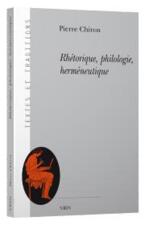
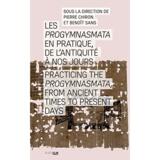
Progymnasmata (preliminary rhetorical exercises) were adopted as pedagogical guides in the Greek world from the Hellenistic period on, and their use widely spread in Europe up to the late 19th century. We rediscover today the potential of this intellectual training, which led young students from writing a fable to defending a bill, as they would enlarge their knowledge, improve their practice of the Greek language, learn how to express affect and to master argumentation. As a course of study, providing a cultural and political training, it is conforted by neuro-pedagody and easily suitable to new media. With this little book, concise and entertaining, and without any equivalent yet, Pierre Chiron gives us the recipe to a successful education at all times, for all.
A philologue, hellenist and historian of rhetoric, Pierre Chiron teaches at the Paris-Est University and is a member of the Institut universitaire de France. For Les Belles Lettres he edited, translated and commented Demetrius’ Du Style treaty(CUF, 1993), the Rhétorique à Alexandre (CUF, 2002), as well as four speeches of Lysias (Commentario, 2015). He is also the author of several books about rhetoric in Ancient times and on its use up to the present day.
Table des matières :
AVANT-PROPOS Qui connaît Aphthonios d’Antioche ? Le cas Lorich Les raisons d’un succès De l’évidence au suspense Idiolecte et décentrement Déjà la logique, déjà l’éthique Déjà l’esprit critique Et après la fable ? L’eau du bain rhétorique Le coup de grâce Pourquoi y revenir maintenant ? Et l’Antiquité dans tout ça ? Fausses différences… … et ressemblances à cultiver Demandez le programme ! La sanction des neurosciences Savoir acquérir mais aussi inhiber les mécanismes Rénover : comment, jusqu’où ?
PREMIÈRE PARTIE : TROIS MAÎTRES Un inspirateur : Isocrate Qui connaît Aélius Théon d’Alexandrie ? Quintilien, père, fils, professeur, élève et citoyen Continuités… … et ruptures
DEUXIÈME PARTIE : LES EXERCICES PROGRESSIFS La fable Le récit La chrie La maxime La contestation et la confirmation Le lieu Éloge et blâme Le parallèle L’éthopée (ou prosopopée) La description La thèse La proposition de loi
TROISIÈME PARTIE : LES EXERCICES QUOTIDIENS La lecture L’audition La paraphrase La réélaboration La contradiction
CONCLUSION Deux regrets Un bilan Un dernier mot Pour aller plus loin
BIBLIOGRAPHIE Sources grecques et latines Pour une première approche du contexte
Notes Biographiques :
Pierre Chiron, helléniste, philologue, historien de la rhétorique, est professeur à l’Université Paris-Est, membre de l’Institut universitaire de France et romancier.